

News
Amendment regarding the storage method for qualified invoices (invoice method), etc.
In the previous Farm News, we introduced the outline of the tax system revision in 2022. Therefore, this time, I would like to take a look at the revision of the storage method for qualified invoices, etc., which has received a lot of attention among the revisions.
1. Parts of the amendment
In the amendment of 2022, "in the case that a tax-exempt enterprise is registered as a qualified invoice issuing enterprise during the taxable period to October 1, 2023, to September 30th, 11th 2029, the tax-exempt enterprise can become a qualified invoice issuing enterprise from the date of registration. " (Act to partially revise the Income Tax Act, etc., Supplementary Provisions, Article 44, Paragraph 4)
The enterprise which submitted the application to the qualified invoice issuing enterprise will be a taxable enterprise from the taxable period to which the registration start date belongs (the enterprise that submitted the application must not be back to a tax-exempt enterprise for two years after the registration start date). (Article 44, Paragraph 5 of the Supplementary Provisions of the Act) In this case, the "qualified invoice" is an invoice that conforms to the so-called invoice method, and it means an invoice that clearly states the consumption tax amount related to the consideration for the goods and services sold for each tax rate.
2. The meaning of this amendment
What does this amendment mean?
This amendment has a time limit, but if an enterprise that intends to become a qualified invoice issuing enterprise submits the application to the qualified invoice issuing enterprise to the head of the competent tax office, it will become a qualified invoice issuing enterprise from the date of submission. In addition, the qualified invoice issuing enterprise will be a taxable enterprise at the same time. Under the pre-amendment provisions, even if you submitted a registration application in an attempt to become a qualified invoice issuing enterprise or taxable enterprise, you could not immediately become a qualified invoice issuing enterprise. As a general rule, you could only become a qualified invoice issuing enterprise from the tax period following the tax period to which the date of submission belongs. Similarly, the enterprise could only become taxable enterprise from the next taxable period.
3. The calculation structure of consumption tax
So, what does it mean to be a qualified invoice issuing enterprise and a taxable enterprise?
To answer this question, it is necessary to understand the calculation structure of consumption tax.
(1)The calculation structure of consumption tax
Consumption tax is a tax borne by consumers, but they do not go directly to the tax office to pay their consumption tax. Enterprise (companies or employers) who keep consumption tax from consumers calculate the amount of consumption tax to be paid by themselves and pay the tax amount to the Government.
The way to calculate the tax amount to be paid is below.
・Consumption tax amounts received by consumers― Consumption tax paid by the enterprise
Why does it have a mechanism to deduct the amount of consumption tax paid from the amount of consumption tax received? That is to prevent tax accumulation.
Please see the figure below. Suppose we purchase a product from a supplier for 1,100 yen and sell it to a consumer for 2,200 yen. (This 1,100 yen is the amount including the consumption tax of 100 yen. The sales of 2,200 yen also includes the consumption tax of 200 yen). For the following explanation, the amount of purchase and sales includes the consumption tax. In that case, we pay a consumption tax of 100 yen when we purchase the goods. And when it is sold, a consumption tax of 200 yen will be collected from the consumer. If there is no consumption tax paid by the supplier, we pay the supplier 100 yen as consumption tax, and the consumer also pays us 200 yen, so we are paying consumption tax of 300 yen for this transaction as a whole. In the end, consumers only buy products for 2,200 yen, but they end up paying 300 yen for consumption tax. The current consumption tax rate is 10%, so paying a consumption tax of 300 yen for this transaction means that you are overpaying the consumption tax.
In this case, there is only one transaction, and only three parties, the supplier, our company, and the consumer, are involved in the transaction, so the overpaid amount is only 100 yen. However, the more the number of transactions with which parties deal increase, the more the overpaid tax amount increase.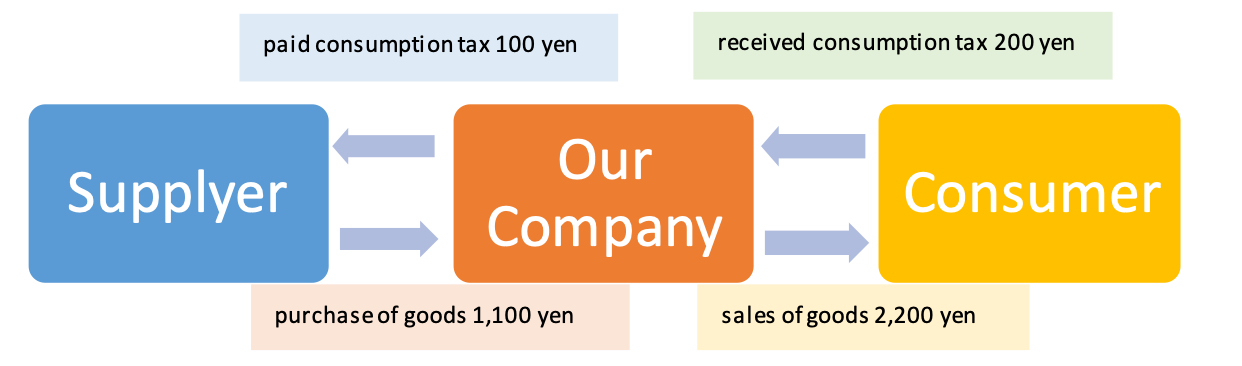
Therefore, in the Consumption Tax Law, in order to prevent the accumulation of such taxes, if enterprise has consumption tax received, the method of deducting the consumption tax paid from that amount is adopted.
In the above example, we have a consumption tax of 200 yen received from the consumer, but since we paid 100 yen as consumption tax by ourselves, we will deduct that consumption tax from the received consumption tax and pay the consumption tax of 100 yen to the Government.
(2)If the supplier is a tax exempt-enterprise
How about if the supplier is a tax-exempt enterprise? Since we are a taxable enterprise, we can deduct the consumption tax paid from the consumption tax we have received. On the other hand, if the supplier is a tax- exempt enterprise, the supplier does not have to pay the received consumption tax of 100 yen to the Government.
Under the current consumption tax law, even if a taxable enterprise purchases goods or services from a tax- exempt enterprise, the consumption tax paid at that time can be deducted from the received consumption tax. In that case, we keep the consumption tax of 200yen and pay 100 yen, so we will pay consumption tax of 100 yen. This is fine. However, since the supplier is a tax-exempt enterprise, the supplier does not need to pay the consumption tax of 100 yen. Therefore, only 100 yen will be paid by us to the Government of the consumption tax of 200 yen paid to us by consumers. But the consumption tax of 100 yen will remain with the supplier without being paid to the Government. This is what the world calls "profit tax."
4. What does becoming a qualified invoice issuing enterprise mean?
So what can we do to prevent such a profit tax? It is necessary for the supplier to become a taxable enterprise. If you are a taxable enterprise, you are obliged to pay consumption tax, so you will have to file a final consumption tax return and pay 100 yen of the consumption tax entrusted to you by consumers. If the supplier pays 100 yen, the consumption tax of 200 yen borne by the nations will go firmly into the national treasury.
If you become a qualified invoice issuing enterprise, you will also be a taxable enterprise. Also, if you become a qualified invoice issuing enterprise, you will have to clearly state the consumption tax amount on the invoice. Clearly stating consumption tax means clarifying the amount to be paid by a qualified invoice issuer. Then, when you receive a qualified invoice, you will be able to deduct the consumption tax amount stated on the invoice from received consumption tax. In other words, we can create a cycle that is faithful to the consumption tax mechanism, which means that we can deduct the consumption tax paid from the consumption tax received and the supplier pays the consumption tax entrusted by the nations.
The invoice method is a mechanism for tax able enterprises to pay the consumption tax borne by the consumer/the nations into the national treasury. If you are a consumer, you may hope that the consumption tax you bear when you purchase goods and services will be paid to the Government firmly, and that your society will improve with the consumption tax as a financial resource. I think that it is a fair tax system that the consumption tax borne by us consumers enters the national treasury as a tax.
5. Meaning of this revision again
This amendment is intended to give early opportunities to new eligible invoice issuers and taxable businesses. By doing so, we are trying to create an early cycle of deducting the consumption tax paid from the consumption tax deposited, and to properly pay the consumption tax borne by the consumption tax to the country.
On the other hand, if a person is not a qualified invoice issuing enterprise, he is not in this consumption tax cycle, so even if you purchase goods or services from him, the enterprise is not able to deduct the paid consumption tax from the received consumption tax. Therefore, the purchaser may stop purchasing from a non-qualified invoice issuing enterprise. In order to prevent such a situation, this amendment has made it possible to conduct an appropriate business as a qualified invoice issuing enterprise and a taxable enterprise at any time.
In the invoice method, a tax-exempt enterprise must become a taxable enterprise, so those who did not have to pay consumption tax until now are obliged to pay consumption tax. Therefore, I am aware that the burden is heavy and there are criticisms. However, the reason why the nations bear to be imposed on consumption tax is that they hope the Government to use it for the benefit of the people. The invoice method is a system that prevents the consumption tax borne by the nations from disappearing in the middle of the cycle and guarantees that the consumption tax will go to the national treasury firmly. We can have a peace of mind.
Should you have inquiries regarding this paper or hope consultation regarding tax affairs, etc., please contact the following.
Tax Consulting Firm EOS
1-1-1 Nishi-Shimbashi, Minato-ku, Tokyo Hibiya Fort Tower 16F
Tel: 050-1743-3900
E-mail: accounting@epcs.co.jp
https://www.epcs.co.jp
Tax Consulting Firm EOS Firm News Vol. 73